
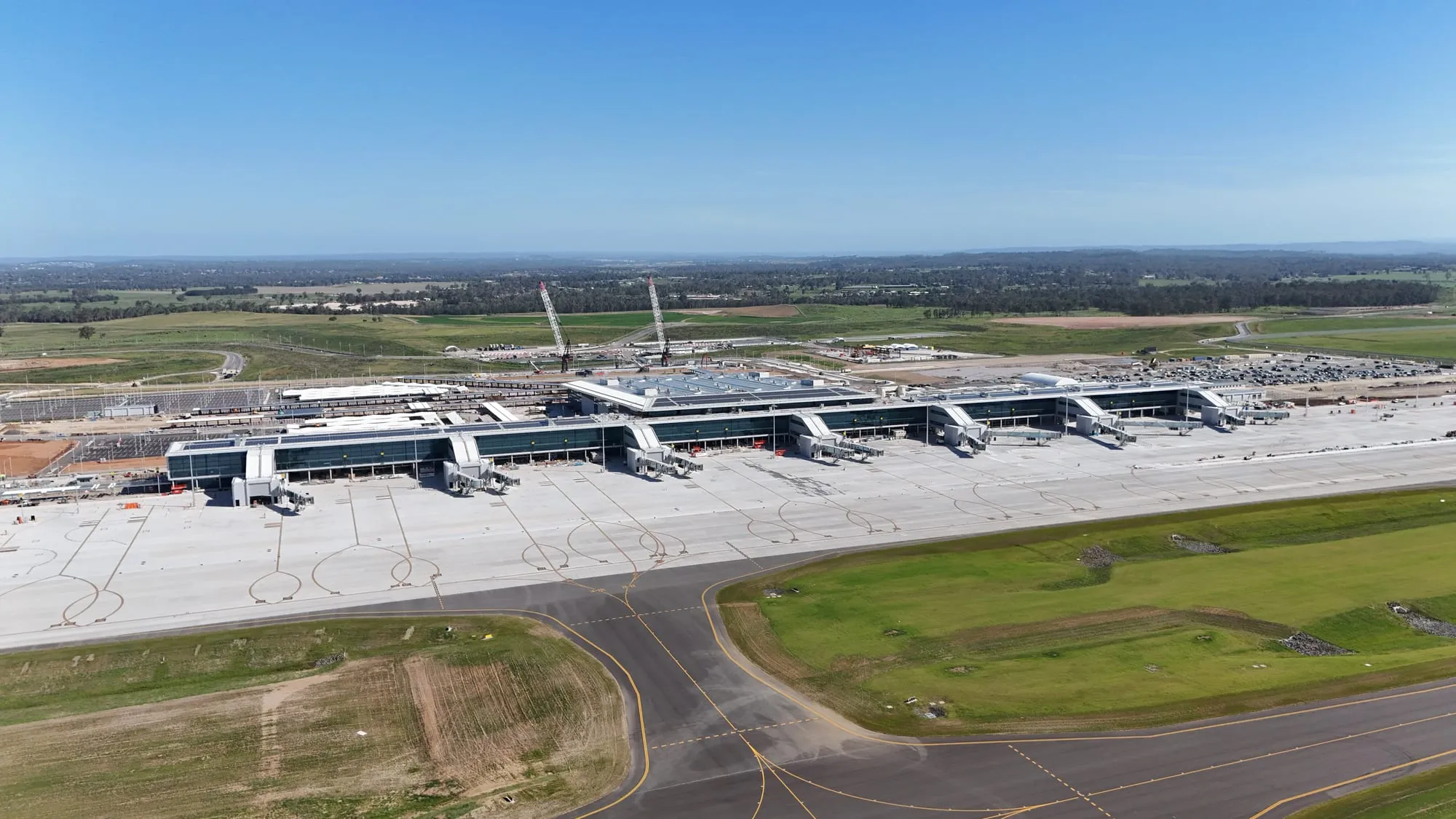
Western Sydney International (Nancy-Bird Walton) Airport will take its first passengers on 25 October, giving Australia’s east coast a major gateway able to operate at any hour and triggering the largest change to Sydney’s air network since an overnight curfew was legislated in 1995.
Jetstar will run the opening service, flight JQ362 to the Gold Coast, departing at 11am. The carrier will fly up to 14 services a week to Melbourne, four to the Gold Coast and three to Brisbane on Airbus A320s. Air New Zealand begins three weekly Auckland flights on 26 October. Singapore Airlines starts daily services to Changi on 23 November.
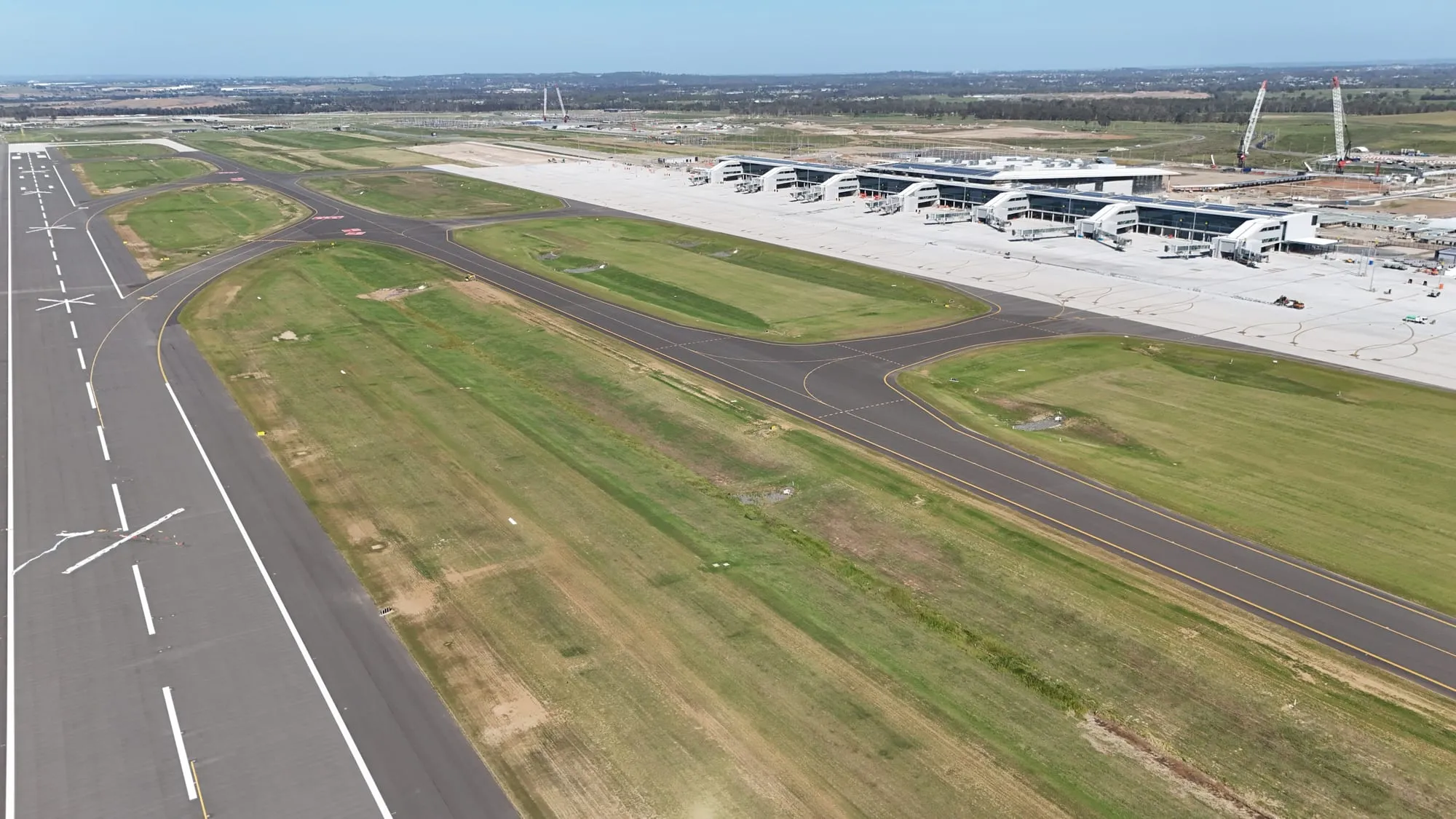
The airport sits at Badgerys Creek, about 44 kilometres west of the Sydney CBD, on 1,780 hectares with a single 3.7-kilometre runway. It was built by Commonwealth-owned WSA Co with up to $5.3 billion in federal equity, inside a wider package of close to $18 billion covering road upgrades and a future metro line. Initial capacity is 10 million passengers a year.
Forty years of not building it
The Commonwealth has owned the land since the Hawke government named Badgerys Creek as the site for Sydney’s second airport in February 1986. Acquisitions ran from 1986 to 1991 and cost about $170 million, assembling the parcel the airport now occupies. Nothing was built on it for a generation.
The reason was a decision taken alongside it. The same government approved a third runway at Kingsford Smith, and once that was underway the case for a greenfield airport thinned. Aviation minister Bob Collins turned the first sod at Badgerys Creek in June 1992 and predicted it would become one of the southern hemisphere’s most important airports. Work stopped shortly afterwards.
The third runway opened on 4 November 1994 and reset the politics of the whole question. Noise over the inner west and north shore ran beyond what the environmental impact statement had forecast, and the No Aircraft Noise Party formed in response. It polled heavily at the March 1995 NSW election, which Bob Carr won on the strength of that anger. His majority was confirmed four days later when one final seat fell to Labor: Badgerys Creek.
The Sydney Airport Curfew Act followed the same year, closing Mascot to scheduled movements between 11pm and 6am and pushing departures out over Botany Bay. The Act also identified a future western Sydney airport as the place night flights would eventually go, a provision that takes effect this November, 31 years later.
John Howard’s government investigated Holsworthy as an alternative from 1996, rejected it in 1998, confirmed Badgerys Creek as the preferred site in 1999, then shelved the project in 2000 while keeping the land. Its 2004 election policy ran to a single line: “We will not build a second Sydney Airport.” Labor had already left the field. Simon Crean ruled Badgerys Creek out for the party in 2003, backed by transport spokesman Martin Ferguson, who argued the site belonged to the 1980s.
The 2002 privatisation added a further obstacle. Sydney Airport’s new owners were granted a right of first refusal over any second Sydney airport, handing the incumbent the first claim on building its own competitor. A joint Commonwealth and NSW study in 2012 found Badgerys Creek was clearly the best available site. The Abbott government designated it in April 2014. Sydney Airport assessed the offer for three years and declined it on 2 May 2017, citing risk to investor returns. The Commonwealth then set up WSA Co to build the airport itself, and earthworks began in September 2018.
Anthony Albanese held the inner-west seat of Grayndler through the third runway backlash and told parliament in his 1996 maiden speech that Labor had been written off there because of it. As prime minister he will open the airport that backlash ultimately produced, and his government is the one moving night freight west.
The constraint being lifted
Mascot has been closed to scheduled movements between 11pm and 6am for three decades. A second law, the Sydney Airport Demand Management Act 1997, caps movements at 80 an hour. Together the two rules compress Sydney’s entire schedule into a 17-hour window and leave airlines almost no recovery margin. An aircraft running late in the evening either lands before 11pm or does not land at all, and delays that cascade toward the deadline end in cancellations and out-of-position aircraft.
Singapore Airlines has built its Western Sydney schedule directly around the absence of that limit. Flight SQ202 will leave at 11.55pm and reach Changi at 5.05am, feeding the carrier’s morning departure wave to Europe, India and South East Asia. The inbound service arrives at 10.20pm. Neither timing is legal at Mascot. The route will use Airbus A350-900s carrying 303 passengers, lifting Singapore Airlines to five daily Sydney services across the two airports.
Air New Zealand has taken the other end of the clock. Its aircraft leaves Auckland at 6.05am, lands at 7.50am, turns and departs again at 9am for a 2.15pm arrival, putting passengers into the airline’s afternoon bank for Los Angeles, San Francisco, New York and Houston.
Both schedules are tests of the same proposition. If a midnight departure fills reliably, the same logic applies to any carrier running a dawn connecting bank out of a northern hub, which is the case Emirates and Qatar Airways would need to make internally before committing metal to the route.
The noise moves west
From 1 November, Western Sydney becomes Sydney’s designated airport for overnight movements under the 1995 Act. Freight flights currently permitted at Mascot during curfew hours, up to 74 a week and most of them approaching over Botany Bay, must relocate or reschedule. Exemptions remain for emergencies and special dispensations.
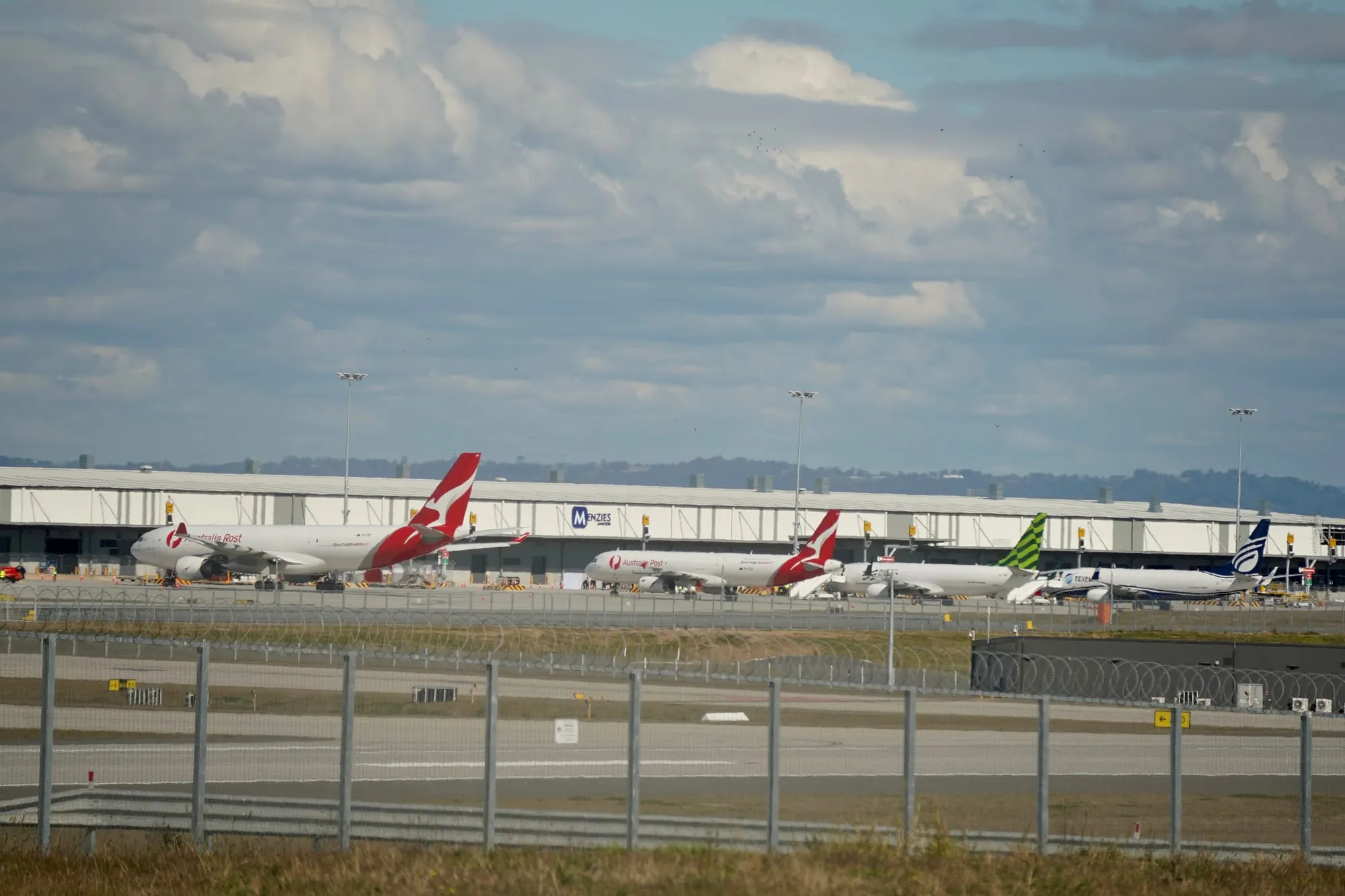
Cargo operations began on 27 July, three months ahead of passengers, with Qantas Freight, Menzies Aviation, dnata and Texel Air as foundation tenants of the 75,000-square-metre precinct.
Residents near the runway have already registered the change. The airport told the ABC this week it had been handling an average of 11 aircraft, or 22 movements, on four nights a week between roughly 8pm and 5.30am, Monday to Thursday. Families in Luddenham reported sleeping only a few hours a night and invited the prime minister and Transport Minister Catherine King to stay over. One resident, a heavy vehicle driver, said he was no longer meeting fatigue requirements.
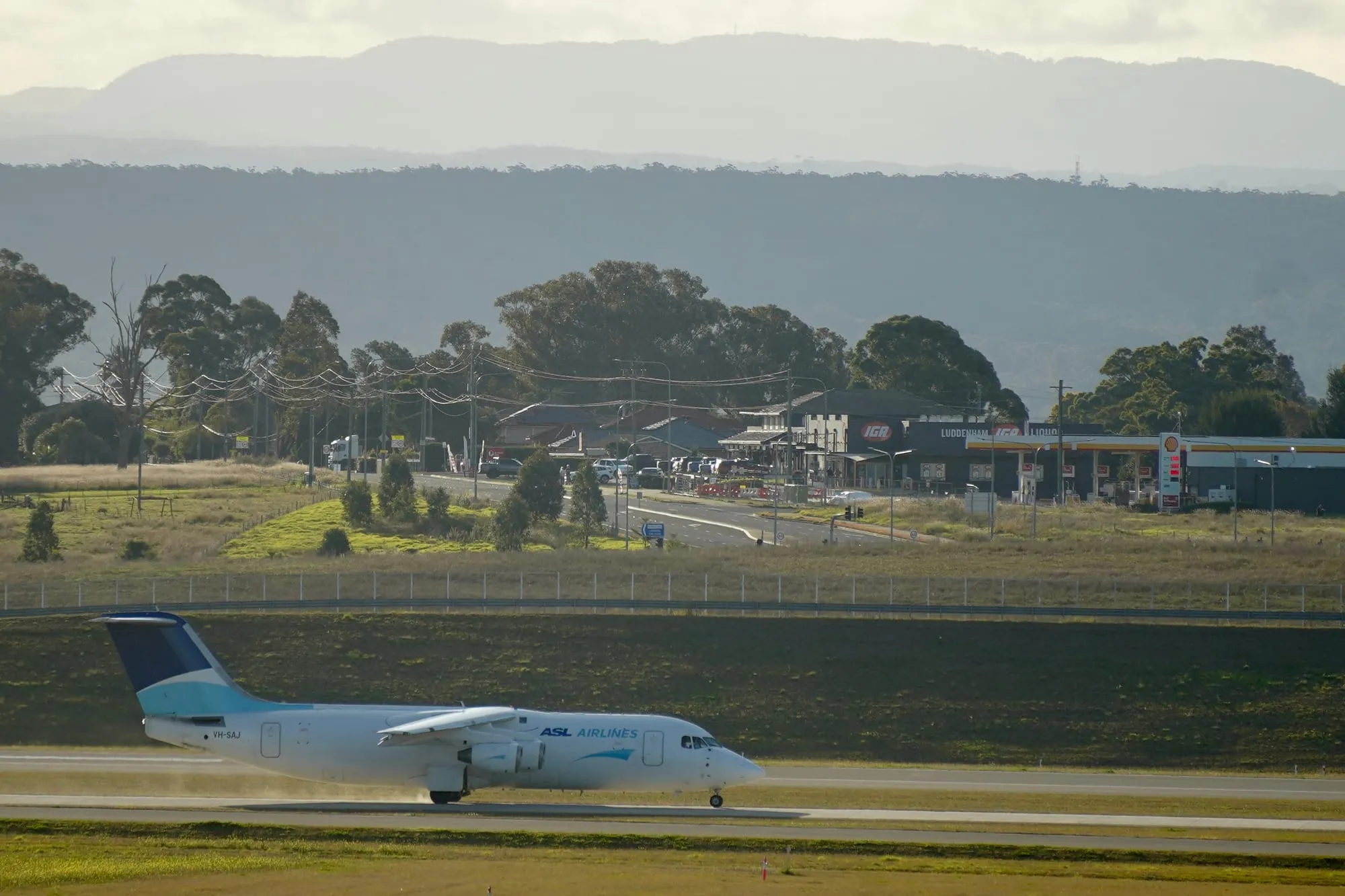
A federal noise insulation program announced in 2023 has not yet delivered. The Department of Infrastructure and Transport confirmed that of 236 eligible buildings across Luddenham, Greendale, Silverdale, Wallacia, Badgerys Creek and Kemps Creek, 129 owners have applied and 74 have been approved, with 17 undergoing acoustic assessment. No installation has been completed. One applicant was told her home may not be assessed until April 2027. Passenger flights start before that, and freight volumes rise in November.
One terminal, both networks
The 90,000-square-metre terminal, designed by Zaha Hadid Architects with Cox Architecture, houses domestic and international operations under one roof. That is the structural difference most likely to change how passengers move.
At Mascot, the international terminal is separated from the domestic terminals by the airfield, forcing transfers by bus or train and inflating minimum connecting times. Western Sydney runs a linear terminal of about 560 metres with 14 gates and 13 aerobridges, several configured to switch between domestic and international use through the day. An aircraft can arrive from Melbourne, unload into the domestic concourse and board an international departure from the same stand without a tow between aprons.
Processing is common-user rather than airline-specific: 40 check-in kiosks and 34 automated bag drops available to any carrier, computed tomography scanners that do not require laptops or liquids to be removed, and facial recognition in place of boarding passes for adults. The operator is targeting under five minutes from kerb to departures concourse.
What has to go right
The $11 billion Sydney Metro line from St Marys to the terminal and Bradfield will not open with the airport. Construction is behind against a commercial dispute with the Parklife Metro consortium, and the government has not committed to a date. The working target is mid to late 2027, with internal documents pointing to December 2027 and 2028 raised as a possibility if the dispute drags. In the interim, Transport for NSW is running a toll-free shuttle from St Marys every 30 minutes between 4.30am and midnight, plus five electric bus routes to Penrith, Liverpool, Campbelltown and Leppington. The toll-free M12 Motorway, which opened on 14 March, connects the site to the M7. On the state government’s own projection, about 90 per cent of users will arrive by private vehicle at opening.
A slip to 2028 would mean the airport spends its first two summers without rail. That matters most for the traffic the airport is courting hardest. A business traveller booking an 11.55pm departure has to reach Badgerys Creek from the CBD after the working day, and the interim bus network runs to midnight.
Fuel is the other unresolved dependency. Western Sydney opens without an aviation fuel pipeline, so all Jet A-1 arrives by road, an estimated 50 to 65 B-double deliveries a day at initial capacity, on the M7 and M12. Infrastructure Australia has listed a pipeline as a near-term priority, but funding and corridor acquisition are not settled.
The route map is thin. Qantas Group has signed a five-year agreement and plans to base up to 15 narrowbodies at the airport in the first year, about 10 Jetstar and five Qantas, carrying an estimated four million passengers on more than 25,000 flights. Qantas mainline does not start until 28 March 2027, and begins with four weekly services each to Melbourne and Brisbane on QantasLink Embraer E190s of roughly 94 seats rather than 174-seat 737s, an entry timed for the return of corporate demand after the summer. Virgin Australia has not committed.
Internationally, five carriers are signed. Emirates and Qatar Airways were cleared in May for up to seven weekly services each to Dubai and Doha but have not confirmed dates or opened sales. Vietjet will fly twice weekly to Ho Chi Minh City from 10 January 2027 on A330s, adding a third frequency in March, and joint-venture carrier Thai Vietjet plans four weekly Bangkok services from November 2027, subject to approval. Mascot serves about 40 airlines.
That gap defines the next two years. Chief executive Simon Hickey has set out a long-run path to 82 million passengers a year, comparable to Heathrow or Dubai. Reaching even a fraction of it depends on whether the Gulf carriers convert their clearances into schedules and whether Qantas follows through on the Airbus A220, the aircraft its executives have identified as making thin transcontinental routes to Perth and Adelaide viable from Western Sydney. Without those, a 24-hour airport with a curfew-free runway spends its early years running leisure and visiting-friends-and-relatives traffic to three domestic cities and four international ones.
Photographs by BulbazaurREX (terminal, runway) and Helitak430 (freight precinct, Luddenham), released under CC0 via Wikimedia Commons.