
In my perpetual game of extracting Qantas points out of everything and anything, I bought a $100 Apple Gift Card through Qantas Marketplace. The prize was an extra 300 Qantas points and the indefinite suspension of my 12-year-old Apple ID.
Within 48 hours of loading the card, Apple locked me out of the App Store and iTunes. There was no warning and no reason given. Twelve years as a paying customer counted for nothing against a single gift card, bought from a retailer Apple chose to sell through.
What I lost access to
My phone still made calls. Almost everything else stopped. I couldn’t download or update a single app. My paid AppleCare policy couldn’t be managed, changed or transferred. Family sharing, purchase history and iCloud backups were frozen. The most immediate issue was my continuous glucose monitor. I had just applied a new sensor. It’s worth around $140 without government subsidies. And the app refused to connect to it without an update from the App Store. Apple had blocked the update, and the sensor was useless. CGM sensors are single-use. Once one is applied it can’t be removed and saved for later and wasted a sensor the taxpayer mostly paid for.
For a diabetic that is more than an expensive inconvenience. My CGM reads blood glucose every few minutes and alarms when levels drop or spike, including overnight, when a low can set in without me waking up. Losing it means losing that warning. Apple’s fraud system took it away, and I doubt anybody at Apple stopped to consider the health implications of a lockout like this.
The cost I can live with. The bigger loss is that I only get a limited number of subsidised sensors each year, and that one now counts against my allowance. If I run out, new sensors cost about $140. Whilst I haven’t asked, I suspect that getting it replaced would be like extracting blood from a stone. The sensor isn’t faulty, so the manufacturer has no reason to replace it, and since Apple won’t even explain why it disabled my account, I doubt they will be willing to pay for a new sensor.
Dealing with Apple support
Getting it fixed meant going through Apple support, where nobody I spoke to had the authority to fix anything.
Chat support was the first wall. Agents refused to escalate and gave vague answers, telling me the account had been disabled for a breach of Apple’s terms and conditions without saying which term or when the breach took place. After finally getting a chat agent to escalate, I was put through to a senior advisor who was helpful at first. They told me a completely different story: my record was clean, and an automated batch flag tied to the gift card had caught me. They asked if I could upload the Qantas tax invoice, the digital delivery receipt with serial numbers and my matching bank statements through Apple’s secure portal and I dutifully did.
Both chat and phone support suggested I just create a new Apple ID, as if twelve years of purchases, backups and an active AppleCare policy didn’t matter. Apple had accused me of breaching its terms, which I didn’t. Its fix was to open a new account to get around the suspension, when those same terms forbid circumventing Apple’s security technology, which suggests getting around a ban by any means is itself a breach. Apple’s staff accused me of breaking the rules, then told me to fix it by breaking them.
I was also told that buying Apple gift cards from any supplier other than Apple is at the buyer’s own risk, including the risk of having your account suspended.
After three days of no contact from support, I followed up and reached a second senior advisor who was confused by the whole process. Working through the notes on my file, they advised me that the first advisor had never lodged the dispute or forwarded my documents and were unsure of what the first agent had even done. They “investigated” the issue on their end and shortly after they advised that the automated system rejected the appeal and closed the file permanently. They added that even if they wanted to help, the override controls on their screen were greyed out. Nobody on phone or email could take it further.
The support agents’ advice for a final escalation was to post a letter to Apple’s offices in Singapore.
A company that runs one of the largest digital payment systems in the world told me to use the post. It is hard to read that as anything other than a deliberate choice to make appealing as slow and painful as possible, in the hope that most people give up.
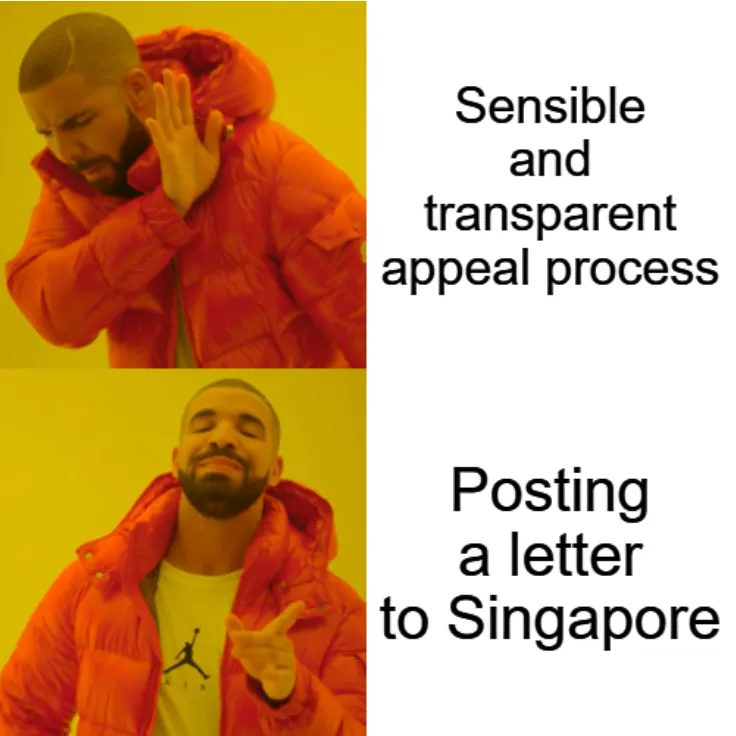
At least the 300 points cover about 1 per cent of a one-way economy reward seat to Singapore to drop the letter off in person.
A pattern Apple knows about
I wasn’t the first. A cursory Google search will find plenty of examples, like one from December 2025, when fellow Australian developer Paris Buttfield-Addison lost a 25-year-old Apple ID after attempting to redeem a $500 gift card they purchased at Woolworths. Apple support suggested the card might have been tampered with. Paris sent the receipt with the serial number and store. The account stayed disabled, and they were pointed to a postal address too. Apple gave them the same advice I got: buy gift cards only from Apple. Eventually they were able to get their account back but only after spending nearly a week kicking up a massive media stink.
Apple knows the system gets people wrong. It has chosen not to give its own staff the power to correct it, and Australian laws are ill-equipped to assist consumers in restoring their access.
What Apple owes customers in Europe
In Europe, it wouldn’t get that choice. The Digital Services Act, which covers account suspensions on online platforms, sets out the minimum requirements that Apple owes a customer in my position.
| Requirement | Article |
|---|---|
| A statement of reasons for the account action, including how automated tools were used | DSA Art. 17 |
| A free internal complaint system, open for at least six months from notification | DSA Art. 20(1) |
| Complaints handled in a timely, non-discriminatory, diligent and non-arbitrary manner | DSA Art. 20(4) |
| Decisions made under the supervision of qualified staff, not solely by automated means | DSA Art. 20(6) |
| Access to out-of-court dispute settlement before a certified body | DSA Art. 21 |
Every one of those failed in my case. I got no real reason, an appeal that was lost and then closed by a machine, and no one who could review it. Apple already builds these processes for customers in the European Union because the law makes it. It doesn’t offer them here because nothing does.
Those standards have teeth. The European Commission designated the App Store a very large online platform in April 2023, which puts Apple’s compliance under the Commission’s direct supervision rather than a single national regulator. Breaches can draw fines of up to 6 per cent of global annual turnover, plus daily penalties of up to 5 per cent of average daily turnover for every day a fix is delayed. Users refused a fair hearing can also complain to the Digital Services Coordinator in their member state. The Commission has shown it will use those powers: in December 2025 it fined X €120 million in the first non-compliance decision under the act.
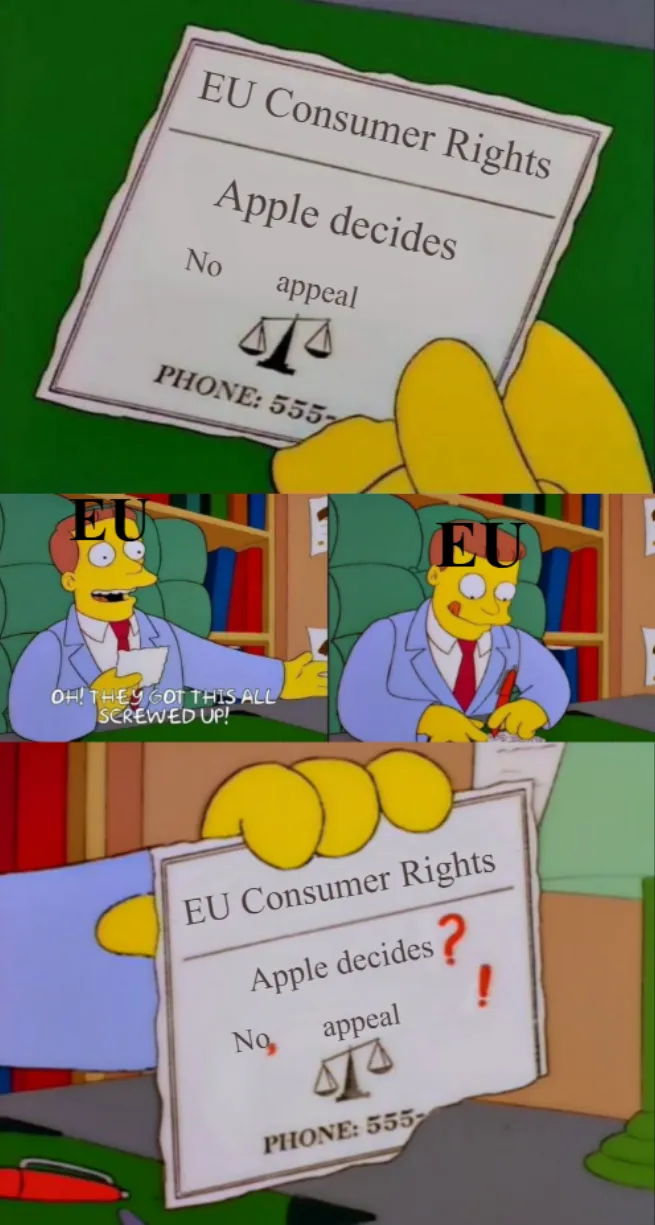
If it weren’t for my Qantas points balance, I’d already be packing for Germany.
What Australians get instead
On paper, Australians aren’t without rights. The Australian Consumer Law guarantees apply to services supplied here regardless of what Apple’s terms say, and the unfair contract terms regime covers standard form consumer contracts. But enforcing either against Apple means a lengthy and complicated tribunal filing, and Apple is counting on most people not bothering.
The ACCC saw this coming. The fifth report of its Digital Platform Services Inquiry, released in 2022, recommended mandatory minimum standards for internal dispute resolution and a digital platform ombuds scheme backed by legislation, with penalties for platforms that refuse to take part. None of it has been enacted. On 7 May 2026, the Digital Platform Regulators Forum, made up of the ACCC, ACMA, the eSafety Commissioner and the Office of the Australian Information Commissioner, issued a joint statement supporting minimum dispute resolution standards for disputes that fall outside the Scams Prevention Framework and existing ombudsman schemes. Four years on, the regulators still agree there’s a problem, and an account lockout like mine still has nowhere to go.
What legislation does exist misses the problem. The Scams Prevention Framework, passed in February 2025, offers dispute resolution against some digital platforms, but only for scams. The Unfair Trading Practices Bill, introduced in April 2026, targets dark patterns and subscription traps and creates no ombuds scheme. Neither would have given me anyone to complain to or assist in resolving the issue.
How it ended
What eventually worked had nothing to do with any of Apple’s processes. I yolo emailed a smattering of executives directly, including current CEO John Ternus and ex-CEO Tim Cook. A few days later the App Store came back, my glucose monitor app updated and the account returned to normal. Apple sent no email and no explanation.
I still don’t know why my account was disabled, why the appeal was refused or why it was restored. I don’t even know who restored it. It could have been the executives I emailed, the first advisor’s elusive escalation finally surfacing, some kind of divine intervention, or maybe in the end Apple made it “just work”.
If you’re buying Apple gift cards for points maybe reconsider next time because the real cost may be a decade of purchases and data sitting at the mercy of a system that Apple’s own staff aren’t allowed to question.